Nectar sources
Our honey is produced from local nectar sources. Each kind of flower produces a honey with its own distinct taste and properties. There are specific times
of year when nectar sources are readily identifiable and we harvest the resulting honey separately. When nectar sources are mixed by the bees or are
generally unknown, it is labeled as "wildflower." Frequently, we have wildflower honeys that are different from each other in some way and we assign them a
special name.
The quantities of honey we harvest are totally dependent on the production of our bees and the seasonal conditions.
Our usual floral sources include basswood, goldenrod and knotweed. Wildflower honey frequently in stock includes spring and August wildflower.

How our honey is made
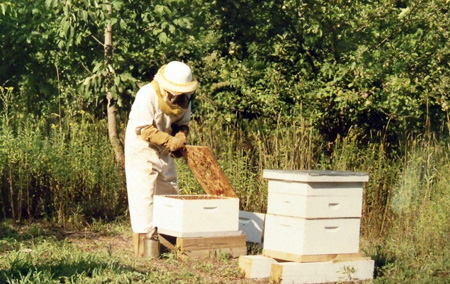
Honey is a unique mixture of flower nectar and bee ingenuity. Our bees and bee hives are managed without the use of antibiotics, anti-fungals, or pesticides. We use natural selection and non-chemical beekeeping techniques to raise
bees and queens.
Each bee in the hive has a specific job. Field workers gather flower nectar and bring it back to
the hive in a special stomach-like storage chamber. They also gather pollen on their body hairs and they pack it into pollen "baskets" on their legs.
At the hive entrance, the field bee is greeted by "house" bees who "unload" the nectar and transport it up to the honey comb area used for ripening.
House bees distribute the ripening nectar into multiple cells. Additionally, each bee adds enzymes to the nectar and house bees fan the nectar-laden
cells to speed evaporation. When the honey has become thick and fully ripe, the bees cap the cells with a beeswax seal. The boxes of honey
comb frames at the top of the bee hives are called supers. Each box holds nine frames of honey comb totalling about 45-50 pounds of honey. The honey is
harvested at Leo's Honey House starting at the end of June with our final harvest near the end of September.
At the honey house, frames are removed and the caps of the cells are removed enmasse with a hot knife. The frame is then put in a device called
an extractor that uses centrifugal force to "spin out" the honey. The empty frames are given back to the bees for refilling. The honey is bottled and
ready to eat. Pure raw honey has been the standard at Leo's Honey House since the beginning.

Raw & ultra-raw honey
Raw honey is popular for its flavor and health benefits.
Our raw honey can be purchased filtered and unfiltered. Filtering removes the bees wax and large particles in the honey, yielding the traditional sparkly clear honey.
This honey is typically bottled in 8oz, 16oz & 2 pound jars.
Unfiltered raw honey or "ultra-raw honey" is bottled right from the extractor. It still contains the bits of comb honey, pollen, and bits of propolis - all contributing
to the full honey experience. This product is popular with people using honey for its health benefits.
Ultra-raw honey crystalizes quickly and most containers have some degree of crystallization when purchased.
A specific amount of each variety is bottled as ultra-raw. These quantities are limited. Ultra-raw can be purchased in 1 1/2 pound, 2 1/2 pound and 5 pound containers.
Comb honey is cut from the frames in varying sized pieces ranging from 6-8 ounces to 1 pound chunks. It is the most natural and
un-fooled-around-with honey. This is the honey enjoyed by our ancestors. The delicate beeswax framework is completely edible.
Honey Facts and Storage Hints
Honey is a revered and mysterious product derived from flower nectar. Honey bees process the nectar into the sweet syrupy liquid we love. One of honey's mysteries
is crystallization. This is a natural process involving the chemistry of highly concentrated sugar solutions. All honey eventually crystallizes. Crystallization is
not spoilage and is totally reversible. Gently heating the crystallized honey returns it to its liquid state. Some people use a pan of very warm water. Others prefer the
microwave on a low setting and for 20 to 30 seconds at a time. When reliquifying honey, remove the lid first and avoid boiling.
Comb and liquid honey should be stored at room temperature. Storing your honey in the freezer gives the longest time before crystallization. Refrigeration speeds up
the crystallization process and should be reserved only for honey butter. Creamed honey has been allowed to crystallize through controlled conditions giving it its
unique spreadability and is best stored at room temperature. Creamed honey may be warmed in the microwave for a few seconds should it become hard and difficult to spread.
Comb honey should be eaten as soon as possible to avoid crystallization of the honey within the wax cells. The product then takes on a gritty texture, which is
unpleasant for some people. Crystallized comb honey is great for baking.
Honey lovers should make purchase of enough honey for use within the year so as to always have the freshest possible product. However, in a tightly sealed container,
liquid and creamed honeys have a usable shelf life of many years even at room temperature.
Supermarkets are a common place to purchase honey. Unfortunately, the honey found there will probably be pasteurized, blended, and of questionable purity. While
pasteurization is thought to increase shelf life before crystallization, it also has a detrimental effect on flavor, vitamin, and antioxidant content. It is best
to avoid honey produced in foreign countries. Honey from some countries has been banned in the US due to the detection of antibiotics in the honey.
The very best honey is being produced by your local beekeepers. You may want to try honey produced from the different floral or nectar sources. Ask your beekeeper about
the different varieties he or she has to offer. Beekeeping is a difficult and specialized farming activity, yet is vital to the pollination of our food crops. Your
purchase of honey from a local beekeeper not only provides you with the best of nature's sweet treats but also supports an important link in American agriculture.
|